Excerpts from
The
Life Magnet Vol. 4
by
Robert Collier
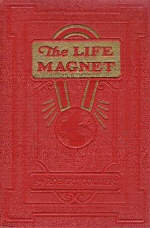
Order in Adobe PDF eBook or printed form for $5.95 (+ printing charge)

Book
Description
This is part of a set of 7 books that Robert Collier
published in 1928 as a follow-up series to his highly successful
"Secret of the Ages.". The first 2 books in this series were entitled
"The Secret of Gold", and the remaining 5 were entitled "The Life
Magnet." Original copies of this series are now very hard to find.
The chapter titles of this volume are:
Chapter 1 - The Secret of Matter
Chapter 2 - The Mystery of Life
Chapter 3 - The Elixir of Life
Chapter 4 - Pathways of the Mind
Chapter 5 - The Dangers of Living
What These Books Will Do for You
"The Life Magnet" will show you how
to get what you want--how to draw to yourself riches and power
just as surely as the magnet draws to itself every filing of iron that
comes within its reach. There is nothing of good you can ask for, that
it cannot bring you.
Scientists tell us, you know, that all mankind is created
equal----that
the brain of one man is exactly the same as that of another. The only
difference between a failure and a successful man is that the
successful man's brain is more developed.
But here is the important part--These scientists tell us
that no
man has found the way to use more than one tenth of
the giant power of his brain. And the prime purpose of "The Life
Magnet" is to point out in plain language the way to harness the vast
reserve power of this Giant Inside You--the way to use it to
bring you whatever you want.
There are no vague theories in these books. They show you
first
just
what is this giant unused power within you, then how to reach it and
finally how to make it work for you every day and hour.
Chapter
1
The
Secret of Matter
"For He looketh to the ends of
the
earth, and seeth under the whole heaven."—Job 28:24.
"TELL me not in mournful
numbers," goes the first
line of a poem we used to recite in my school days, and ends with—"and
things are not what they seem."
Truly, they are not. Not in
these days of black rays and
violet rays which give up the innermost secrets that Nature has
concealed from
man for so many thousands of years.
With the aid of the "invisible
light" or
"black light" of the ultra-violet ray, Dr. Herman demonstrated to the
Illuminating Engineering Society in Washington that many things
were very far
from being what they seem. Under the powerful ray of this lamp,
things
otherwise not distinguishable to the human eye stood out as bodly as
in
black-face type. Counterfeit money took on an entirely
different color.
Otherwise invisible erasures were instantly seen. Even ink
manufactured by the
same company, but of slightly different age, changed its color entirely
under
the "black" rays. False teeth stood out like lumps of chocolate.
False hair was easily distinguishable. Invisible ink became legible. It
was
even possible to read the printing on the opposite side of a newspaper.
To quote the New York Sun of
October 3rd—
"In a world that always has
loved a good paradox, what more
delightful one could be imagined
than that of
seeing things by invisible light?
It has long been known that such
light existed
and that objects
could be photographed in its rays, but it is only recently that
investigators
have discovered a way to make it reveal its presence directly to our
eyes.
"During an electrical
convention in Colorado Springs
the other night the garden of a hotel, flooded with beams from
powerful
searchlights which to human sight seemed absolutely dark, was turned
into a
ghostly picture in which strange and unnatural colors glowed upon
shrubbery,
fountains and costumes of men and women amid an enveloping atmosphere
of gloom.
"The
invisible light employed in experiments such as this is the ultra
violet. If
the human eye be compared to a radio receiving set, the ultra-violet
rays may
be likened to short-wave transmission which the ordinary set is
incapable of
picking up. If our eyes were constructed differently we might see
ultra-violet; as it is, this light is blackness to our limited vision.
"In noctovision, the invention
of the Scot Baird, dark
rays of a different kind are used—the long-wave indra red at the
opposite end
of the spectrum. Baird's apparatus does not disclose objects in a dark
room to
the observer's eye, but transmits an image to a screen which may be
many miles
away."
For thousands of years,
philosophers have been telling us
that there are around us such entities as "things in
themselves"—things
we could not see or smell or touch. Now we can believe them.
For the first time, actual
pictures of the air are
being made—by the Schlieren process, perfected in Germany. The study of
air
pockets, which have cost so many aviators their lives, is thus made
possible. Air
currents, air "holes," all bow to this new method of research.
In certain German towns, the
police have been furnished
with ingenious devices which enable them to sound alarms unheard
by any but
each other. These devices are whistles which blow—not sounds, but
ultra-sounds.
Just as the ultra-violet ray produces light rays of such high frequency
that they
do not register upon the human retina, so the ultrasound
waves from these
whistles produces sound waves of such high frequency that the unaided
ear
cannot detect them. Yet the Police Post with proper "detectors" can
get them at once.
As Charles Lordman says in Le
Matin:
"Our
senses are tiny receptacles of very small
dimensions, not adapted to hold all the
vibratory riches of the surrounding universe. An interesting tale, a
la Wells,
could be written—or several of them—about imaginary men provided with
sense
organs whose limits of action were different from ours.
"If our ears were sensitive to
ultrasounds and not to
sounds, we should hear—if I may use the word—the ultra-whistles of
the German
policemen. If they were sensitive to 'infra-sounds'—that is to
mechanical waves
slower than the lowest audible sounds, we should perceive at a distance
the
swaying of trees in the wind, the oscillations of barometric
pressure and the
slow movements of the earth beneath our feet.
"If our eyes were sensitive to
the infrared rays, we
should see and discern at a distance, even in the dark, other men and
animals,
and we could even distinguish many objects which emit only the
heat-rays of the
spectrum.
"If our retinas were directly
sensitive to the
Hertzian waves, life would become insupportable; for because of
the formidable
mixture of waves that unceasingly traverse the atmosphere, we
should live in a
chaos of sensation. We should have to blind ourselves to get any peace,
or shut
ourselves up in metal closets—metal being opaque to electric radiation.
We
should see a revival of the medieval knights in their steel shells!
"But
if we could perceive the X-rays, and those alone, then indeed would the
aspect
of the universe become fantastic. In full daylight we should no longer
see the
sun; we should not suspect its existence from direct evidence. And
in the
darkened sky, we should see only certain of the stars and nebulae—those
that
send us the mysterious celestial X-rays of which we have recently been
hearing.
"All is appearance. The universe is to us only what
we are to
it"
In short, when we say that we
"see" something, we
merely mean that waves of light of a certain frequency and length are
beating
against our optic nerves and our retina is able to detect them.
Millions of
rays of different frequency and different lengths pass by unnoticed.
Just as,
when a musical note is pitched too high or too low, our ear drums are
not
attuned to the sound waves and we fail to hear them, so the light waves
have
pitch (which we call color) and when the pitch is too rapid or too
short, our optic
nerve is unable to catch them.
So at last we are coming to
agree with St. Paul that
"Eye hath not seen nor ear heard, neither have entered into the heart
of
man, the things which God hath prepared for them that love Him."—1
Corinthians 2:9. Once the scientist said, in the same spirit as
Job—"With
God all things are possible," but these are things "too wonderful for
me, which I knew not." Now it would be a hardy soul who would say that
anything is impossible for God's image—Man.
"Say not ye," said Jesus (John
4:35), "There
are yet four months, and then cometh the harvest? Behold, I say unto
you, lift
up your eyes and look on the fields; for they are white already to
harvest."
Doubters scoffed at such a
possibility then.
Doubters still scoff at the
idea now. Yet listen:
"Recent
experiments with combinations of daylight supplemented with
artificial
light," says Floyd Parsons in Advertising and Selling, "proved
beyond doubt that many plants can be grown from seed to maturity in a
remarkably short time. Spring wheat has been brought to maturity in 38
days by
using this method. A crop of clover was grown from seed to flower in 38
days.
"The possibilities for future
experiments in this
field are tremendous."
He then goes on to point out
some of the numberless
opportunities in Nature all about us, which we have scarcely begun
to use, and
ends with—
"It all goes to show how slow
we are to understand and
utilize even the most common of Nature's bounties."
Dr. H. J. Muller of the
University of Texas has shown
through experiments with flies that it is possible to speed up the
reproduction
process, producing evolutionary changes or "mutations" 150 times
faster by the use of X-rays. He expects later to put that discovery to
practical use with plants and larger animals.
In past ages, in the immaturity
of his mental development,
man dealt only with things he could see or feel or hear or taste. His
five
senses were the only guides he trusted. If he could not detect a thing
through
them, it was not. True—he believed in a vague sort of way that
there was
a God—but He was high up in the heavens out of reach of mortal sense.
Today, in his more mature
mental development, man is
concerned with ideas. Ideas that cannot be seen or heard or tasted or
felt. Yet
ideas that are just as real as any object detectible by the senses—in
many
cases, more real. Like Plato, we have come to believe that ideas are
the
perfect immaterial pattern of which all material things are but
imperfect
copies.
This is the age of ideas.
Through them, man is for the
first time learning the infinite powers in his hands.
"And God said, let us make man
in our image, after our
likeness; and let them have dominion over the fish of the sea, and over
the fowl of
the air, and over the cattle, and
over all the
earth."—Genesis 1:26.
Long before they had discovered
all the known elements of
matter, scientists knew exactly how many there were, what the missing
ones
consisted of, where they belonged. How? Through mind, through ideas.
Now science has penetrated the
secret of matter in the
earth and the stars, and can literally do for itself in a few days what
Nature
has been doing for us through ages. How? Through the product of man's
ideas—the
X-ray. To quote Waldemar Kaempffert in the New York Times—
"It takes a million million
atoms to fill the head of
a pin, yet the X-rays indicate the position of every one. Atoms have
ceased to
be the smallest hypothetical units of matter. They have become as real
as
bricks—the architectural material of a new chemistry which is mimicking
nature.
"Clutch
a piece of iron. It seems substantial, dense, continuous, all that is
implied
by the word "solid." Look at the stars above. How remote from us, how
remote from one another! Stellar distances must be measured by
light-years—so
empty is space. Yet the piece of iron that you clutch is relatively
just as
empty. Magnify it to the dimensions of the solar system, and its atoms
would be
separated millions of miles. Hundreds of comets have swept through the
solar
system without colliding with a planet. A comet far smaller than an
atom might
theoretically swim through a seemingly solid piece of iron just as
readily.
Science has compelled us to modify the traditional conception of
"solid" matter.
"With the introduction of the
X-rays into the chemical
laboratory we have crossed the threshold of a new scientific era.
Suppose a
metal is wanted that can be rolled out into a sheet or drawn into a
wire
without cracking. The chemist draws a space-lattice in which each atom
is tied
to three others on either side. Thereupon he indicated how that metal
is to be
produced. Thus the metallurgist of the future will literally compose in
his
mind, or on paper, alloys to meet specific industrial requirements."
"If our planet were constantly
covered with
clouds," said Flammarion, "we should know nothing of the sun, nor the
moon, nor the planets, and the world system would remain unknown,
with the result
that human knowledge would be condemned to an irremediable
falsity. Illusion
forms the unstable basis of our ideas, our sensations, our sentiments,
our beliefs."
Illusion—yet we are beginning
to lose some of it. The
ultra-violet ray of understanding will dispel more.
"Whatsoever things are true,
whatsoever things are honest,
whatsoever things are just, whatsoever things are pure, whatsoever
things are
lovely, whatsoever things are of good report; if there be any virtue,
and if
there be any praise, think on these things."—Philippians 4:8.
Our
ancestors thought the earth was a fixed object. Our children today know
that it
moves, but only as they learn it from books. Our ancestors thought the
earth
was flat. We know it to be round, but only as it is proved to us. Our
senses
would still tell us it is a fixed body—in spite of the fact that it is
rushing
through space at a dizzying speed, the plaything of fourteen different
movements,
making a complete revolution every 24 hours.
We would never know from our
five senses that the air we
breathe has weight. We cannot sense the electricity all about us. We
cannot
detect more than a small part of the light or sound waves, or the
odors, in the
air around us. In short, if we depended on our five senses, we should
be as
ignorant of all that is going on about us as is the savage.
And yet people can still be
found to say—I see a certain
thing, or I feel a certain thing, or I hear a certain thing, so I
know it to
be so. Man, man, the things your five senses tell you, are the
things you
can be least sure of. They don't know the hundredth part of what is
going on
around you—and least of all do they know the things they seem surest of.
What can
your ears tell you of the music and lectures and reports that are being
broadcasted all about you this very minute? What can your eyes tell you
of the
images that are being telegraphed past you in every direction through
television,
or the mirages that appear on a million light waves? What reliance can
you
place on your unaided sense of touch? Remember, in school boy
initiations, how
they "branded" you by first blindfolding you, then burning a piece of
bacon rind under your nose, the while they clapped a chunk of ice
against the
place to be "branded"? And if you had no advance information of what
was really going on, the ice hurt as much as a hot iron, for the
sensation of
intense heat and intense cold is just the same.
Or your sense of taste?
Remember how they fed you—still
blindfolded—a raw oyster, telling you all manner of dreadful things?
And how
readily your sense of taste accepted those suggestions?
To trust the testimony of your
five senses rather than the
testimony of your reason is foolish in this day and age. As far as the
physical
senses are concerned, today is the day of uncertainty. According
to them, the
moon is larger than the sun, and the earth is the center of the solar
system.
Our new conception of the
universe is based entirely on
mind. According to the Einstein theory, we are not only somewhere
in space,
but somewhen. It is not events which are happening now, but
our
perception of them. If it takes years for light to travel from the
planets to
us, what we see through our telescopes is not what is happening there
now, but
what happened years ago. It is as though we had years ago been marooned
on a
remote island and a passing steamer dropped a 10-year-old newspaper
giving us
our first knowledge of the war. To us, with nothing by which to reckon
time,
that war would be now. To the world, it is past and gone.
More and
more we live in a world of mind's making. Just as, in many industries,
the
profits now lie in the things that formerly were thrown away, so the
future of
the race lies in the fields that heretofore have been not only
unexplored but
undreamed of. "For the invisible things of Him from the creation of the
world are clearly seen, being understood by the things that are
made."—Romans 1:20.
Quoting Floyd Parsons again—
"Although the most abundant of
all nature's elements,
air still offers the inquisitive scientist unmeasured
opportunities for
investigative work. Oxygen is found in the air in a perfectly free
state and
yet we have not perfected a way to utilize this most common element on
a large
scale in concentrated form. Eventually cheap oxygen at a dollar a ton
will revolutionize
all of the metal industries as well as gas manufacture. Laboratory
practices in
chemistry and medicine will likewise be materially improved.
"For years science has
discussed the possibility of
the development of a safe explosive; one that would reduce the hazards
of
industry, be unworkable in the hands of assassins and yet would be
abundant and
low in cost. Liquid oxygen would seem to be the substance sought."
Dr. J. F. Norris, President of
the American Chemical
Society sees the power in the atom changing our whole life. He sees the
synthesis of food without the slow process of passing through the
vegetable
kingdom. He sees our knowledge of matter so broadened that what we know
today
is but the foreground of the great picture that is to come.
"Their
line is gone out through all the earth, and their words to the end of
the
world. In them hath He set a tabernacle for the sun. His going
forth is from
the end of the heaven, and his circuit unto the ends of it; and there
is nothing
hid from the heat thereof."—Psalms 19:4,6.
Dr. Umberto Pomilio, the noted
Italian chemist, visions
the emancipation of mankind from the use of coal and other
energy-producing
materials, and atomic energy heating the world.
An English engineer, John L.
Hodgson, told the British
Association for the Advancement of Science that the internal fires of
the earth
could be made to supply fuel for the world's needs for centuries to
come, and
proceeded to suggest a plan for utilizing this boundless heat.
"For we know in part, and we
prophesy in part.
"But when that which is perfect
is come, then that
which is in part shall be done away.
"When I was a child, I spake as
a child,
I understood as a
child, I thought as a child: but when I became a man, I put away
childish
things.
"For now we see through a glass
darkly; but then face
to face: now I know in part; but then shall I know even as also I am
known."—I Corinthians 13: 9-12.
Dreams wilder than the wildest
of Jules Verne's stories are
becoming everyday realities now. Why? Because man no longer puts a
limit upon
himself or his powers. He knows that anything is possible to him,
and
thereupon proceeds to turn the seemingly impossible into everyday
reality.
Remember,
in The Mysterious Island, how Captain Nemo killed the pirates
with a gun
that used no bullets, but shot a mysterious ray, fatal to anything it
touched?
A wild dream of the imagination, we thought then. But Dr. Robert W.
Wood of
Johns Hopkins found that sound waves of a high frequency can be
directed in a
well-defined beam. And when testing them in the water, a fish happened
to swim
through the path of the rays. The next moment that fish was a dead
fish!
In chemistry, they have what
they call catalytic agents.
Take a little potassium chlorate, as an instance. Heat it. Nothing
happens.
But add just a touch of manganese dioxide—and the chlorate gives up
oxygen,
while the manganese remains unchanged. The manganese is a catalytic
agent. It
releases the constituent parts of the potassium chlorate, while
itself
remaining unaffected.
Mind is the great catalytic,
but we are only beginning to
learn how to use it. It brings out the real from under all the forms
which
appear to our naked senses. It shows us the substance beneath.
Do you know where we get the
word substance? From sub and
stare—to stand under. Substance is the real that stands under
all its
visible forms. When you look at an object, you do not see the
substance—you see
only what corresponds to that substance to your eyes. You get only a
small and
unimportant number of the light rays it refracts.
"While we look not at the
things which are seen, but
at the things which are not seen. For the things which are seen are
temporal.
But the things which are not seen are eternal.
—II
Corinthians 4:18.
When you
look at yourself in the glass, you do not see your real self—you see
only your
idea of it, the idea you have been accustomed to accept because it is
all your
physical senses have been able to grasp.
The real substance you have
never seen.
The millions of protons and
electrons of which it is
made—each a miniature solar system—are entirely beyond the ken of our
ordinary
senses. The perfect image of God in which the real body is made—we
can't see
this with our eyes.
These are mental concepts. They
must be grasped mentally.
They must be controlled mentally. But once we do grasp them, once we do
control
them, our body becomes the servant instead of the master—it becomes the
image
and likeness of its Creator.
It is only this real substance
that matters. And it is to
help you to find this real substance that "stands under" all the
imperfect outer forms, that this book is written.
"I have heard of Thee by the
hearing
of the ear: but now mine eye seeth thee."—Job 42:5
Order complete book in Adobe PDF eBook or printed form for $5.95 (+
printing charge)
|